Product Overview
The NUMOBAMS ZAY7045V is a floor-standing drilling and milling machine — an industrial milling machine built around a 1.5 kW (2 HP) spindle motor and a vertical column. The headstock lifts electrically, the spindle speed is adjustable across the range, and the metal T-slot table rotates on a graduated scale, so a single setup can run from a drilled hole pattern to a milled slot to an angled face. The machine arrives complete on its cabinet base with the coolant tank, pump and hose, an adjustable work lamp and a transparent spindle guard already fitted. The body is finished in green and grey.
It is a metal milling machine for a working shop rather than a shelf. Job shops use it for brackets, base plates and short production runs; maintenance departments use it to re-face a flange or drill out a sheared stud instead of waiting on an outside machinist; prototype and fixture builders use it because the table swings to an angle and the head lifts to height without a crank. It is also an easy machine to teach on, because everything the operator needs to read — the speed setting, the angle scale, the cut itself — is visible from the front.
We put the specification together with a small group of milling machine manufacturers in China and handle the order, the inspection and the shipping ourselves. That means the accessories, the documentation and the electrical configuration are agreed before the machine is packed, not negotiated after it lands.
Key Features
- 1.5 kW spindle with adjustable speed – enough torque for a face mill in aluminium and for drilling mild steel; you match speed to the cutter and the material instead of forcing one setting through every job.
- Electric headstock lifting – the head rises and falls under power, so moving between a drill chuck and a milling cutter no longer means winding a crank and re-clamping.
- Rotatable table with a graduated scale – the table swings and is marked in 10° steps to 30°, which puts angled slots, chamfers and dovetail work on the table instead of on a stack of angle plates.
- Metal T-slot table – a vice, clamps or a fixture bolt straight into the slots, so this bench milling alternative is ready for real work the day it lands.
- Coolant tank, pump and hose – flood coolant keeps the cutter and the workpiece cool on deep cuts and flushes chips clear of the flutes.
- Work lamp and transparent spindle guard – the lamp rides an adjustable arm so you can light the exact edge you are cutting, and the guard sits between your hands and a spinning spindle.
- Parts and continuity – wear parts are reachable, the electrical panel is accessible, and the team that supplies the machine can tell you what it was built with. That continuity matters more than a headline price when you compare milling machine suppliers.
Specifications
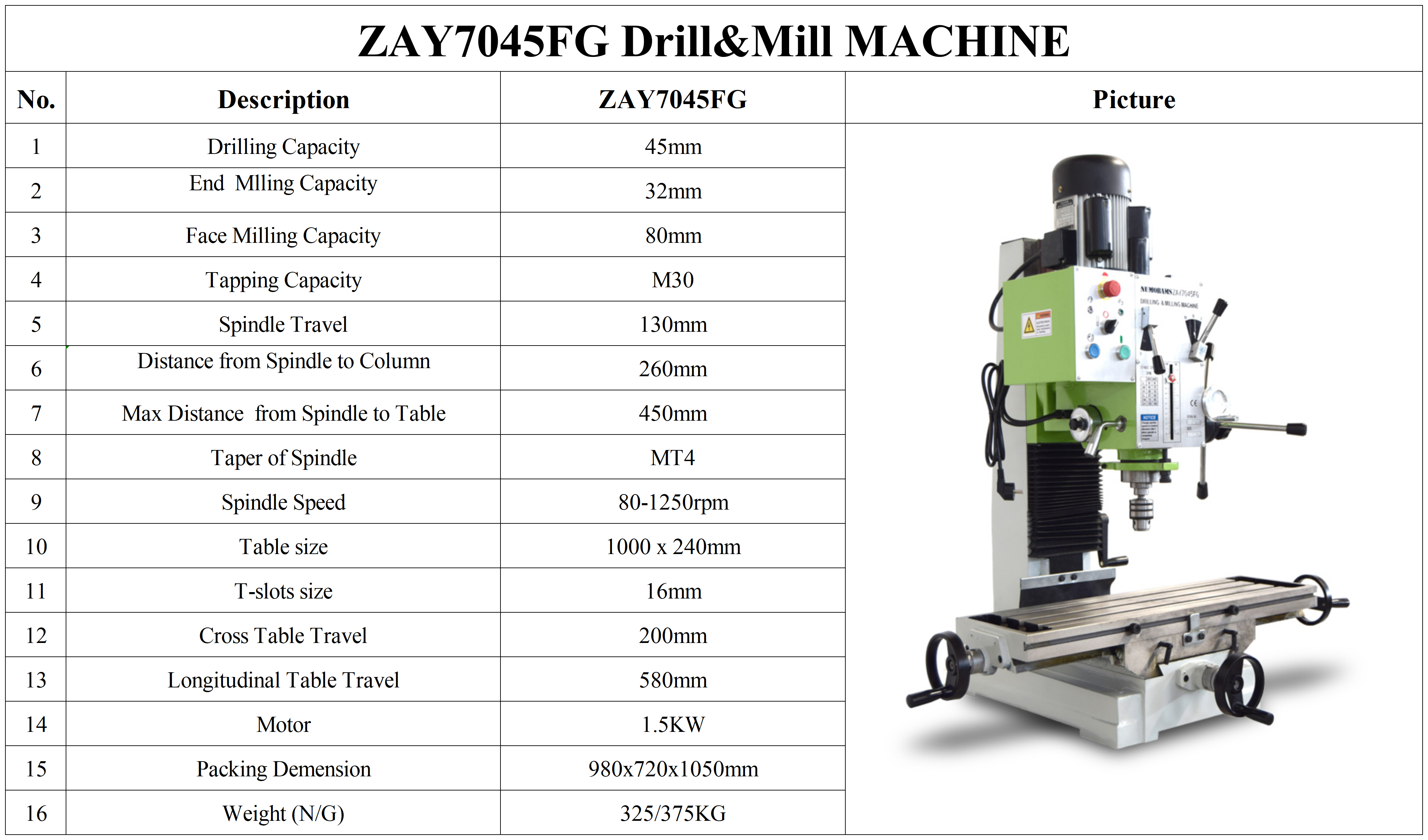
| Model | ZAY7045V |
|---|
| Machine type | Vertical drilling and milling machine, floor-standing |
| Spindle motor | 1.5 kW (2 HP) |
| Power supply | 220 V single-phase or 380 V three-phase |
| Head control | Electric headstock lifting with adjustable spindle speed |
| Table | Metal T-slot table, rotatable with a graduated angle scale |
| Cooling | Coolant tank, pump and hose |
| Lighting and guarding | Adjustable work lamp and transparent spindle guard |
| Base | Cabinet stand |
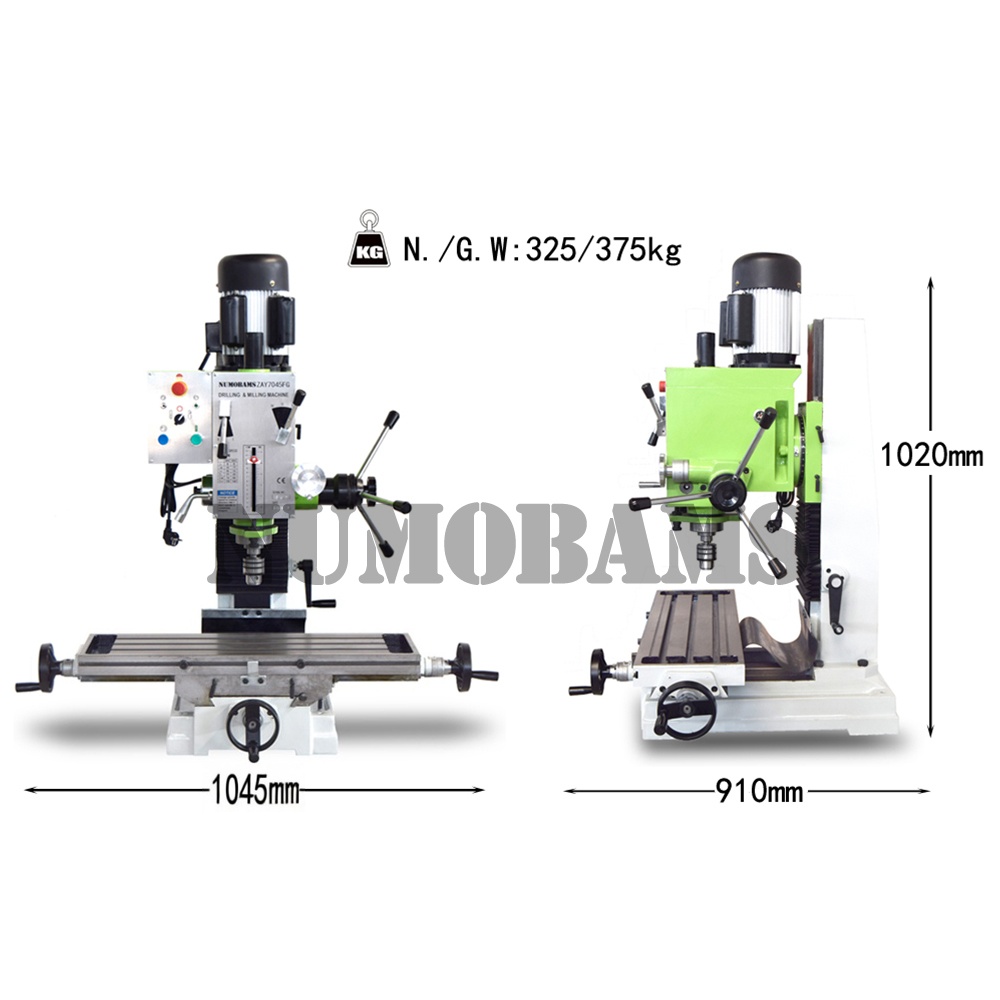
| Overall dimensions (W × D × H) | 1045 × 910 × 1020 mm |
| Net / gross weight | 325 kg / 375 kg |
| Optional equipment | Additional accessories to extend the machine's capability |
Product Advantages
Rigidity you can see in the finish
The head is carried on a column with dovetail ways, and the column is bolted to a cast base that sits on the cabinet. That chain matters on a vertical milling machine because a milling cut pushes the cutter sideways as well as down: the stiffer the chain, the less the cutter is pushed away from the work. In practice you get less chatter on a heavier pass, a cleaner surface on steel and aluminium, and more life out of inserted cutters before the edges dull.
Accessories that extend the machine instead of replacing it
Optional accessories are available to widen what the machine can do, and they mount onto the base machine rather than substituting parts of it. That lets you buy the configuration you need now — the workholding, the lighting, the readout — and add the rest when a job calls for it, instead of replacing the machine when the work changes.
Controls laid out for a working day
The control panel is at standing height, the table handwheels are at the front where the operator stands, and the head lift is powered rather than cranked. A second operator can be walked through the industrial milling machine in an afternoon, which matters in a shop where more than one person uses the mill.
A purchase that should still make sense in year three
Milling machine manufacturers are easy to find; a supplier who can still name the parts in your machine three years later is not. We keep the machine, the accessories and the wear parts on one order path, so the second machine you buy matches the first, and a replacement part comes from the same conversation as the original order.
When it is time to move up from a mini milling machine
A mini milling machine is a good first step and a frustrating second one: the vice gets bigger, the cutter gets longer, and the spindle starts to labour on a face cut. This machine is the bench milling alternative that answers that with more spindle power, a heavier head and a table that will take a proper machine vice, while still fitting into a single bay of a small workshop.
- Measure the floor and the route in – allow for the cabinet footprint, the table at full travel and a clear stance in front; a mini milling machine can sit on a bench, while a workshop milling machine like this one needs its own floor space and a path wide enough to reach it.
- Confirm the supply before it ships – tell us whether the building runs 220 V single-phase or 380 V three-phase, and have the breaker, the isolator and a good earth in place before the metalworking machine arrives.
- Move it on the base – use a pallet truck or an engine crane under the cabinet; keep the head lowered and locked, and never lift by the table, the spindle or the motor housing.
- Level the cabinet – shim under the base until a bubble reads steady front to back and side to side, then re-check after the first week, when the machine has settled.
- Fill the coolant and set the flow – mix to the ratio on the drum, check that the pump turns the right way, and aim the hose at the cut rather than at the table.
- Run it in without load – take the vertical milling machine through its full speed range, cycle the electric head lift to both ends, and check the lamp, the guard and the table rotation before any metal is cut.
- Take a test cut and write it down – face a scrap block, check squareness and finish, and record the speed and feed. That note becomes the baseline for the next job, and the reference if a cut ever starts to sound different.
Ordering & Delivery
| Dispatch | Within 90 days of order confirmation |
| Delivery service | Tax-free door-to-door delivery service on the routes we support |
| Shipping terms | Confirmed with your sales contact once the destination address is known |
| Payment terms | Confirmed with your sales contact before the order is released |
| Voltage and accessories | Confirmed at the specification stage |
| Packing | Machine on its cabinet base, head locked, coolant tank drained, protected for road and sea freight |
| Documentation | Manual, wiring information and packing list in the crate |
| Wholesale and reseller orders | Volume pricing and long-term supply quoted per project |
| Repeat and mixed orders | Machines, accessories and wear parts can be consolidated into one shipment |
| Pre-shipment record | Photos and the test-cut record can be shared before dispatch |
Maintenance & Care
Working surfaces and gibs
Every few weeks, run a clean rag along the dovetail ways on the column and under the table, oil them, then wind the handwheels through the full travel so the oil reaches the ends of the slide instead of sitting in the middle. The gib strips that take up play in those slides deserve the same look: too loose and a face cutter will chatter on a heavier pass, too tight and the handwheels load up and the ways wear faster. Adjust in small steps and cut a test block each time — the finish tells you which way you went.
Backlash in the table screws
Zero a dial test indicator against the table, turn the handwheel one way and bring it back until the needle moves, and you have the backlash figure for that axis. Write it down. A figure that stays steady is ordinary wear; one that climbs over a few months means the leadscrew nut needs attention, and a climb-milling pass on a slack screw gives a rippled face rather than a flat one.
The spindle taper
Wipe the taper and the tool shank before anything goes in, and never let a chuck sit in a seat that has picked up a chip. A burr on that seat is the most common cause of a cutter that runs out, and it is invisible once the tool is home. When a finish changes and the cutter is known to be good, check the taper with an indicator on a test bar before you blame the machine.
Squareness after a move or a knock
If the machine is shifted across the floor, or takes a knock from a load or a crane, sweep an indicator around the table and re-tram the head before the next job. Then repeat the test cut you made at installation — same block, same cutter, same speed and feed — and compare the two. Squareness and finish drifting together almost always mean the head or the column has moved, not the tooling.
Coolant strength and the tank
Top up with premixed coolant, never neat water, and check the mix strength with a refractometer or the gauge your coolant supplier recommends rather than judging by eye. Skim tramp oil off the surface, keep the suction strainer clear, and change the charge on the coolant maker's schedule, flushing the tank at the same time. A weak mix rusts the table; a stale one smells and irritates the operator's skin.
Chips, slots and the electrics
Use a brush and a vacuum rather than an airline — compressed air drives chips into the ways, the taper and the electrical panel. Keep the T-slots swept so a clamp seats flat and a chip under a T-nut cannot pull the table out of line. Once a month, vacuum dust from the motor fan cover and the panel vents, look over the cable glands and the earth connection, and check that the head lift still runs to both ends without labouring. Note anything you replace — belt, switch, contactor — so a future order matches what is actually on the machine.
Standing idle
If the milling machine will stand for weeks, drain the coolant tank, oil the ways and leave a light film of oil on the table rather than a dry surface. Leave a note on the cabinet saying what was done and when. That note, together with your test-cut record, is what keeps a metal milling machine honest across shifts, across operators and across the years — and it tells you exactly which part to ask us for when something finally does wear out.
Supply Chain & Delivery Assurance
NUMOBAMS is a China-based machinery trading company working from Changsha, Hunan, with a selected network of manufacturing partners built up since 2016. That position lets us consolidate a full workshop order — machines, tooling and spare parts — into one shipment, inspect and prepare each unit before dispatch, and keep spare parts available long after delivery. We ship to Europe, the US and Canada on a tax-free, door-to-door basis, and usually dispatch within 90 days of order confirmation.
FAQ
Q1. Is this a mini milling machine or a full-size workshop machine?
It sits between the two. The cabinet base, the 1.5 kW spindle and the coolant system put it well beyond a mini milling machine, but the footprint stays modest — roughly a metre across and a metre deep, so it fits a single bay. What you gain over a smaller machine is a heavier head and column that hold a face cutter steady, plus a table that takes a proper machine vice. If your parts are consistently larger than this table can swing, tell us before ordering and we will point you at a bigger frame rather than let you buy the wrong one.
Q2. What materials and part sizes suit it?
Mild steel, aluminium, brass, cast iron and engineering plastics are all fair ground with the right cutter and the right speed. The adjustable spindle speed lets you drop down for a large drill or a slitting saw and run faster for a small end mill in aluminium, and flood coolant makes a real difference on steel. Where it is not the right tool is continuous heavy stock removal or hardened tool steel — that work belongs on a bigger, stiffer machine, and it is better to know that before the crate is open.
Q3. Can I have it configured for my own business?
Yes. The voltage is chosen at the specification stage, and optional accessories are available to extend what the machine can do, from workholding to lighting and readout. If you are buying for a specific job, tell us the parts, the material and the vice you plan to use; we will configure around that rather than send a standard machine and leave you to adapt it afterwards.
Q4. How do I set the table at an angle?
The table rotates and is graduated in 10° steps to 30°. Release the table clamps, swing to the mark you need, lock it again, then verify the angle with a dial test indicator against a known face rather than trusting the scale alone. For angles beyond the graduations, or for work where the angle has to repeat exactly across a batch, mount an angle plate or a sine fixture on the table and leave it in place until the run is finished.
Q5. What tooling do I need before the first cut?
At minimum: a drill chuck and a set of bits, a collet or end-mill holder to suit the shank sizes you use, a machine vice, a clamping kit with T-nuts to match the slots, a pair of parallels and an edge finder. Choose cutters that suit the power and speed you have — a large face mill on a light machine is a poor match. Confirm the exact accessory list in your crate with your sales contact so you are not buying the same item twice.
Q6. How do I keep the machine accurate over time?
Wipe and oil the ways at the end of each shift, and never leave swarf packed around the table. Keep the T-slots clean so clamps seat flat, check the coolant mix weekly, change it on the schedule your coolant supplier recommends, and drain the tank if the machine will stand idle for a long period. Check the guard and lamp fixings while you are there. Then repeat your test cut every few months and compare it with the record you made at installation — a change in finish or sound usually shows up there before it shows up in a scrap part.
Q7. Who builds and supports this machine?
NUMOBAMS has been supplying lathes, mills and drilling machines from Changsha, China since 2017, working with a panel of milling machine manufacturers we have used for years rather than a different source for every order. We set the specification, inspect and pack the machine, arrange the shipping, and answer the questions afterwards. The people who take your order are the same people who can tell you what a replacement part should look like.
Q8. Do you keep spare parts after the sale?
Yes — wear parts and consumables stay available after delivery, and we keep a record of what went into your machine so a replacement can be identified without guesswork. Many milling machine suppliers treat the invoice as the end of the conversation; we would rather you came back for the second machine because the first one was still supported.