Product Overview
What this machine is
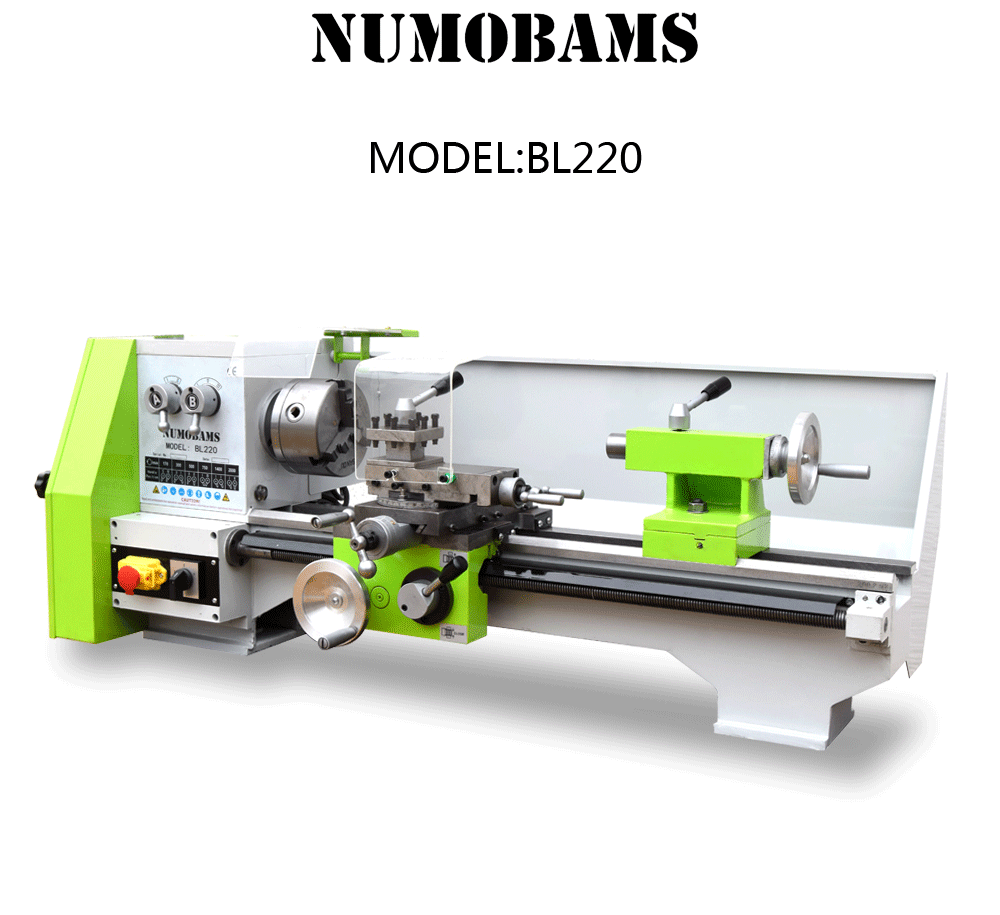
A compact, hand-controlled metal lathe machine for the bench, built around a 220 mm swing and 520 mm between centres — enough bed to hold a shaft at one end and support it with the tailstock at the other. A 550 W AC motor drives the spindle through a geared headstock, speed is set by hand, and the carriage, cross-slide, compound and tailstock all move on handwheels. That last point matters more than it sounds: with nothing between you and the cut, you feel chatter and load through the handwheel and correct it before it becomes a scrapped part.
Where it fits
As a benchtop metal lathe it is sized for a garage, a basement or the back corner of a repair shop, and it belongs bolted to a bench rather than set on a floor foundation. That is the honest trade — you give up the mass and spindle power of a floor lathe and get a machine that fits the space you actually have, runs from a normal workshop supply, and can be moved when you move. Most buyers come to it from hand tools, a drill press, or an older hobby lathe that no longer holds a setting.
What you can do on it straight away
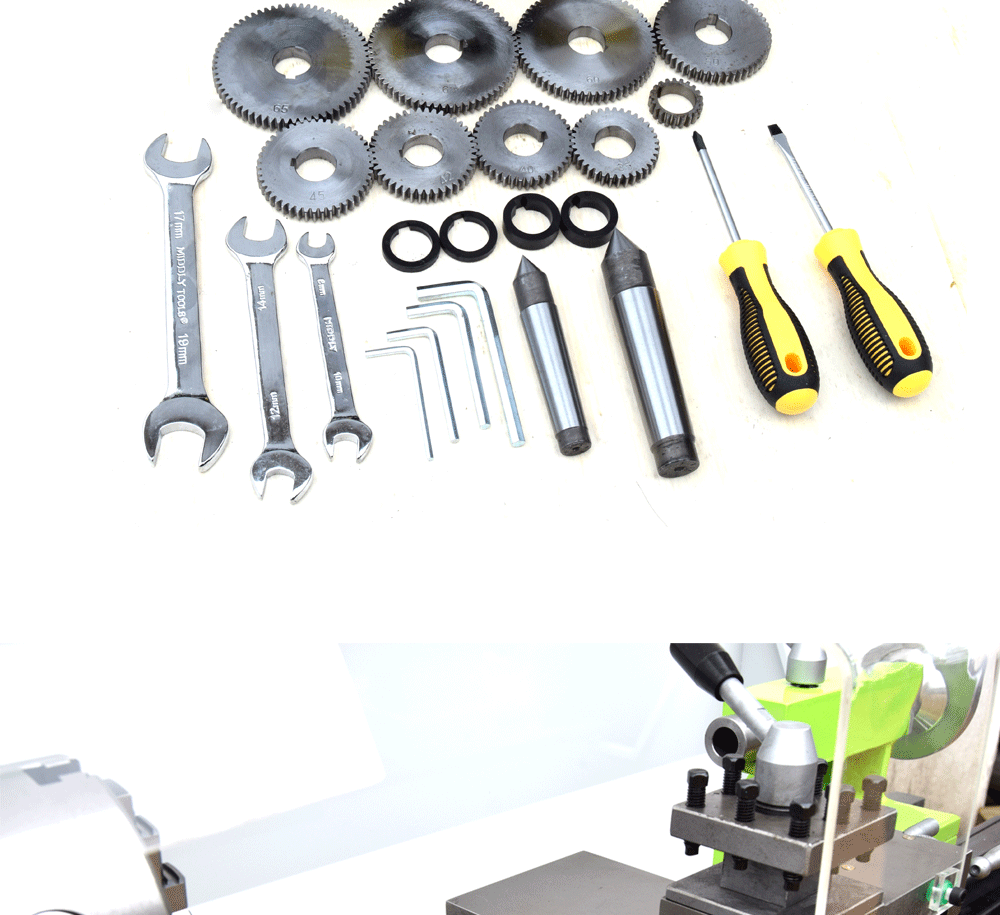
Facing, straight turning, boring, drilling from the tailstock and thread cutting in both metric and inch pitches all happen on the same machine. The change gears that make the threading possible come with it, together with the wrenches, hex keys and screwdrivers needed to swap them. The layout is conventional on purpose: it is the same arrangement you will find on far larger lathes, scaled down to a bench.
Specifications
| Specification | Value |
|---|
| Model | BL220 |
| Swing over bed | 220 mm |
| Swing over carriage | 122 mm |
| Distance between centres | 520 mm |
| Spindle bore | 20 mm |
| Spindle taper | MT3 |
| Spindle speed | 140–1800 rpm |
| Travels (tool post / cross / longitudinal) | 60 / 100 / 500 mm |
| Metric threads | 11 pitches, 0.4–3 mm |
| Inch threads | 11 pitches, 8–56 tpi |
| Tailstock sleeve travel | 50 mm |
| Tailstock taper | MT2 |
| Motor | 550 W AC |
| Net weight | 125 kg |
Build & Workholding
- Conventional layout — bed, carriage, compound and tailstock follow the arrangement used by most lathe machine manufacturers, so standard tooling, standard technique and any existing lathe operating knowledge transfer straight over.
- Spindle and chuck — the spindle is bored through so bar stock can pass back into the headstock, and the 125 mm chuck is supplied as a 3-jaw or a 4-jaw depending on what you order. The 3-jaw centres round and hexagonal work in seconds; the 4-jaw holds castings, off-centre bores and anything that has to be dialled in true.
- Tailstock — the quill takes MT2 drills, centres and reamers, with enough travel to drill and then ream a hole without re-setting the part.
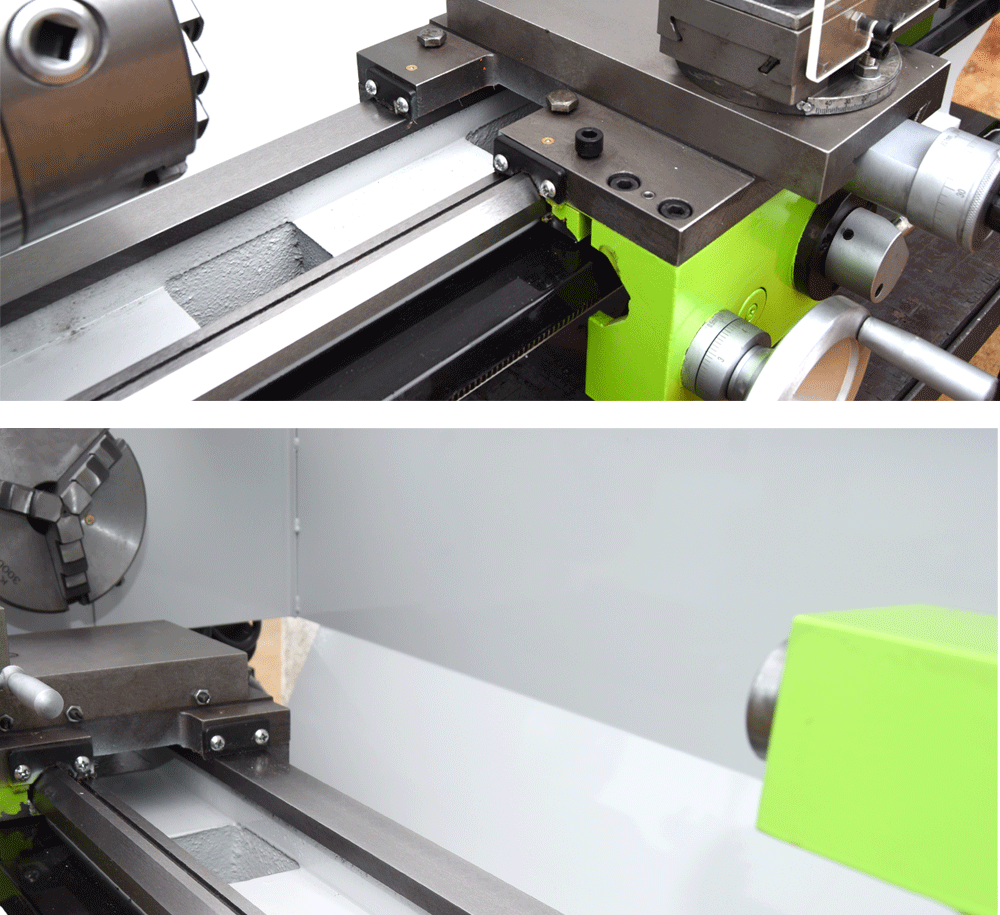
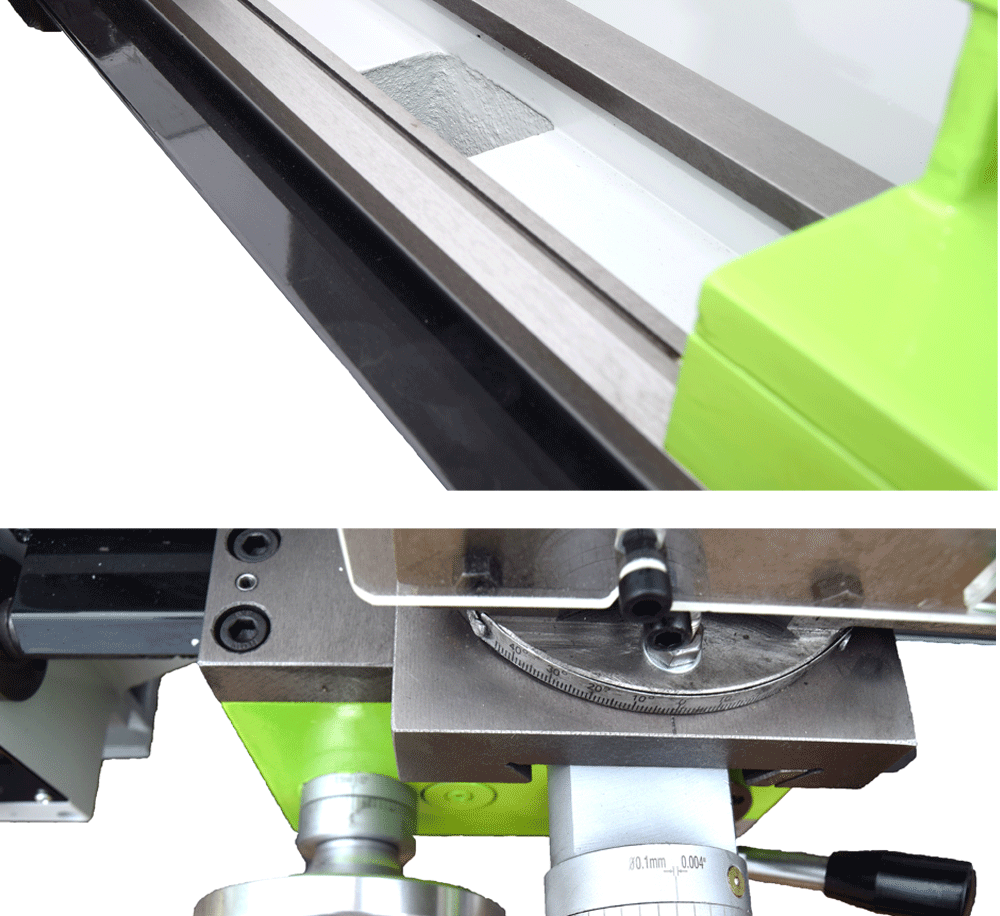
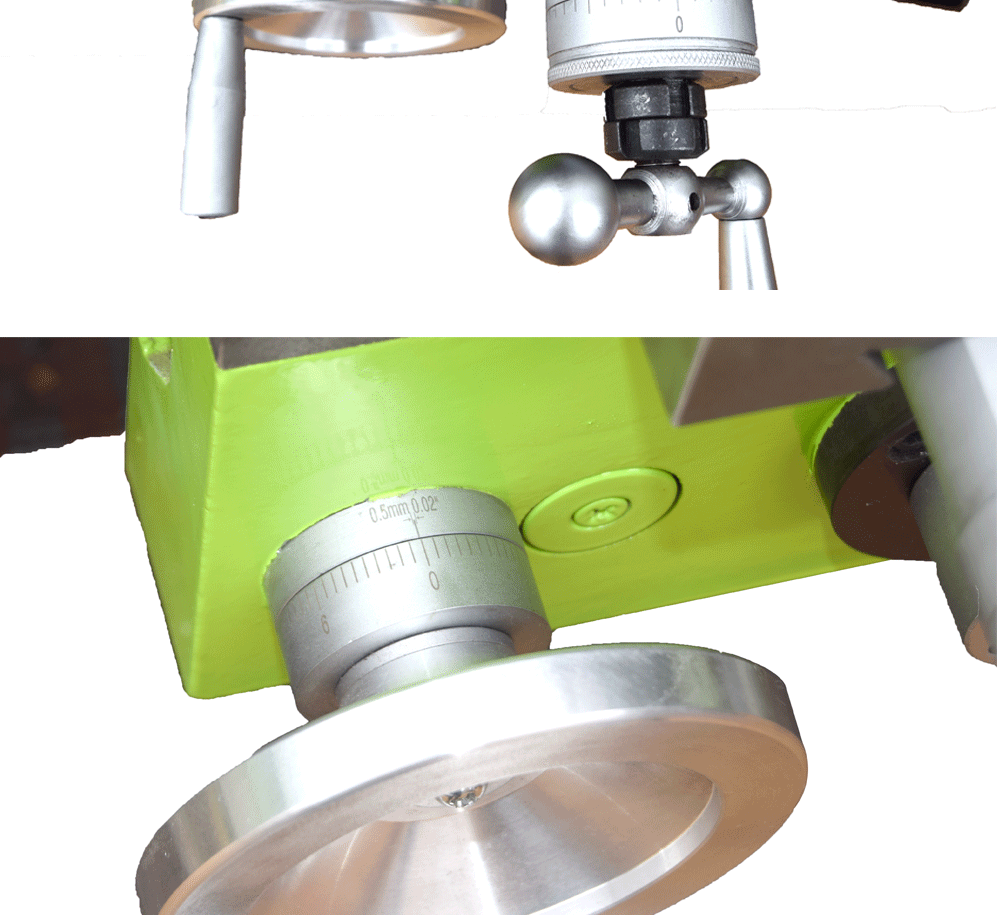
- Tool post and slides — the compound and cross-slide are hand-fed, so you can take a roughing cut and come back for a light finishing pass on the same setting, watching the surface come up as you go.
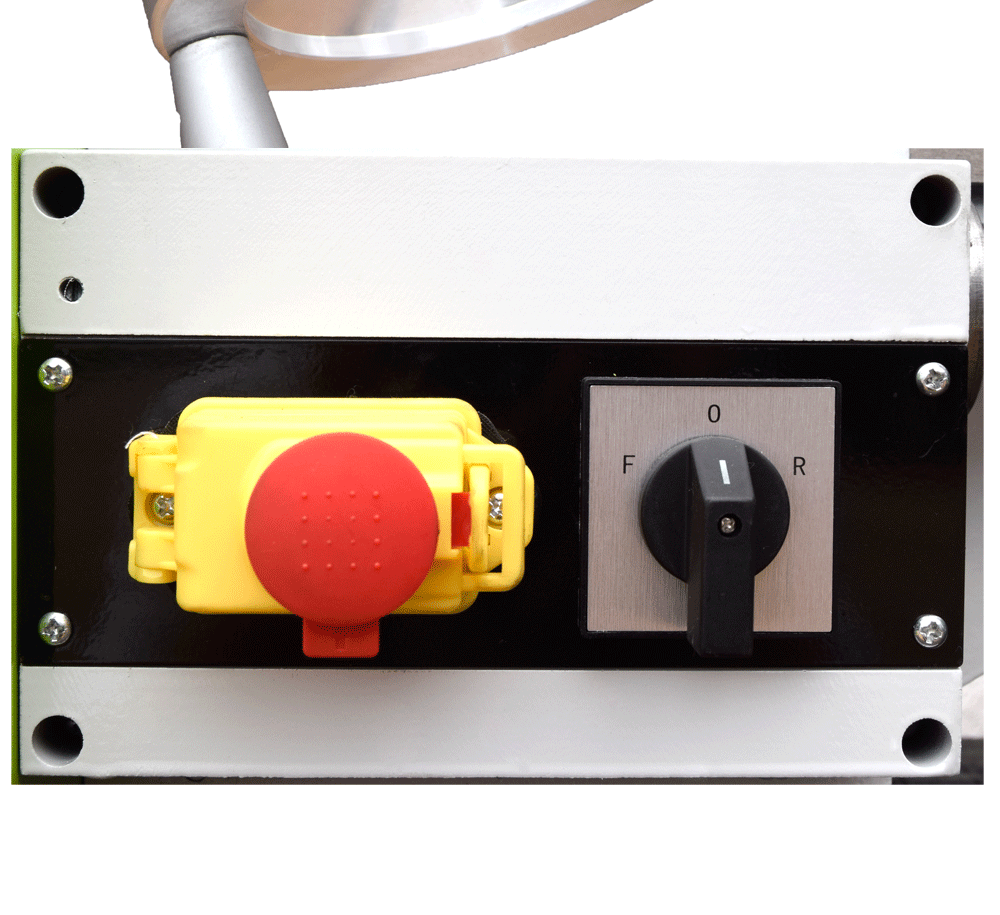
- At the operator's end — a clear guard over the chuck, an emergency stop within reach, and a deliberately plain control panel: motor controls and nothing to learn before the first cut.
- Finish and build — painted green over the machine body with machined surfaces left bright, black handwheels and knobs. It is a workshop machine, so it will pick up oil and swarf; the paint protects the body, it is not there to stay new.
- A diy metal lathe that teaches — every axis is hand-fed, so the machine shows you what depth of cut and feed rate do to a surface. That is the fastest way to learn how a larger lathe will later behave.
Typical Work & Capacity Limits
In a home workshop
In a garage or basement setup this metal lathe machine usually ends the habit of buying parts you could make: spacers and bushes for a rebuild, a new pin for a hinge, a stud at an odd length, a shaft turned down to fit a bearing. Model engineers use it for small frame and mechanism parts, and every home project seems to produce a bracket or an adaptor that has to be made rather than found. Work arrives in ones and twos, which is exactly the pattern this class of machine is built around.
In a repair shop or maintenance room
Here the machine is used the other way round. A worn shaft is turned down and sleeved, a bearing seat is cleaned up, a seal housing is bored out, a one-off fitting is made while the machine it belongs to stands idle. The value is not speed, it is having the capability on site: a job that used to wait three days for an outside machinist is finished the same afternoon.
Where this diy metal lathe stops
Honest limits matter more than adjectives. This is a machine for single parts, small batches and teaching, not production. The spindle power and the hand feeds suit light and medium cuts in aluminium, brass, mild steel and plastics, and they suit heavy stock removal in hard alloys far less well. Long shafts want tailstock support, and anything larger than the swing has to go elsewhere. When your work turns into repeat batches, or diameters creep past what the carriage will clear, that is the moment to look at the NU210X600S or the NU330V Plus — same operating style, more power and more room. For work that is mostly thread cutting, the NU210LSE with its automatic left and right threading saves a great deal of handle-turning.
Product Advantages
- Precision and versatility — turning, facing, boring, drilling, chamfering and parting all come off the same spindle, so a part is usually finished in one setup rather than three. Precision here comes from rigidity and hand control rather than from a control system: a light finishing pass on a properly set tool repeats to the same diameter as long as the machine is not asked for more than it is built to give.
- Robust construction and durability — the weight in the specification table is doing real work. Mass under the cut is what keeps a finishing pass from turning into chatter, and it is why the machine still holds a setting when you come back to it a week later. The wear parts are conventional and replaceable rather than sealed into a unit you have to throw away.
- Technology where it earns its place — the geared headstock keeps torque usable at the slow speeds where boring and larger-diameter turning happen, and thread pitches are selected mechanically through the change gears instead of through electronics that can fail. The parts you touch every day — the emergency stop, the guard, the handwheels — are the ones that got the attention.
- Compact and efficient — the machine sits on a bench or a stand and leaves the bench usable, which is more than most lathes in this class can say. A trolley and two people can move it, so a workshop that doubles as a garage does not have to be rearranged around it. On a manual lathe that is the difference between a machine you use and a machine you avoid.
- Cost-effective for a small business — we buy directly from the lathe machine manufacturer rather than through an import layer, and every wear part can be ordered on its own, so the machine stays economical to own rather than merely economical to buy. For a shop, the return shows up as jobs kept in-house instead of sent out.
Setup & First Cuts
- Prepare a solid bench. Most lathe machine manufacturers assume the machine will be bolted down, and this one is no different: the surface under it has to be flat, rigid and able to carry the machine without flexing. A light worktop will not do — a steel stand or a solid timber bench fixed to the wall will.
- Plan the lift. Take the weight under the bed with a trolley and two people, and never lift by the handwheels, the leadscrew or the chuck. Have the bench ready before the machine comes out of its case.
- Check the supply first. Confirm the machine is built for the voltage you ordered, then check the direction of spindle rotation with the chuck off and nothing in the spindle. If the supply has been wired the other way round, this is the moment to find out.
- Fit the chuck and the guard. Seat the chuck fully on the spindle register, fit the clear guard, and keep the chuck key in your hand — never in the chuck.
- Take a test cut. Chuck a piece of scrap bar, take a light cut along it, and measure the diameter at both ends. Note the numbers; they are your baseline for every later check.
- Re-check after the first few hours. Run the carriage and cross-slide through their full travel and feel for tight spots, adjust the gibs if the slides have freed up, check the belt tension, and oil the ways before the first real job.
Spare Parts & Technical Support
Parts you can buy one at a time
Spares come from the same source as the machine. Because we deal with the lathe machine manufacturer directly, a change gear, a control board, a handwheel or a tailstock quill can be ordered years after delivery — send us the part name, the number stamped on it, or a photograph, and we will match it to your machine.
Help from people who know the model
A benchtop metal lathe is simple enough that most problems turn out to be setup problems rather than failures: a finish that has gone rough, a taper that appears in a cut, a thread that comes out at the wrong pitch. Send a photo or a short video of the cut and we will work through it with you. The answer is usually a gib adjustment, a tool height correction or a change-gear selection, not a new part.
Documentation
Ask us for the operation manual and the wiring diagram that matches your voltage, and for the spare-parts list if you like to keep wear items on the shelf. If you run several machines, tell us which models and we will put the relevant lists together for you.
Ordering, Warranty & Delivery
- Dispatch. Machines are usually dispatched within 90 days of order confirmation; we confirm the date when the order is placed and keep you updated until it ships.
- Delivery. Shipping is arranged as a tax free and delivery to door service, so the machine comes to your address rather than to a port.
- What we need from you. A full delivery address, a contact number and the voltage you need — 110 V or 220 V — confirmed before the machine is packed.
- Packing. The machine travels in a case measuring 1200 × 560 × 540 mm. Keep the packaging until the machine is installed and running; it is the safest way to move it a second time.
- Control board warranty. The control board carries a 180-day warranty from the day you receive the machine. If a board fails inside that period, send it back and we will supply a replacement under the warranty; the terms are confirmed in writing with your order.
- What the accuracy cover means. Coverage is for overall working accuracy, not the precision of every individual component. Each machine is adjusted and calibrated before it is packed, and the accepted check is a cutting test — dismantling the machine to inspect it takes it out of cover.
- Badged builds for distributors. Brand owners and distributors order machines with their own branding for their local market. Tell us the specification and the branding you need and we will confirm what is possible with the lathe machine manufacturers we work with.
- Ask before you order. If you are unsure whether this model suits the parts you make, send a sketch or the dimensions of the largest part and we will tell you honestly whether it fits.
Workpiece Size & Swing
- Swing over bed is 220 mm, the largest diameter that clears the bed casting itself. It applies to short work held in the chuck that never travels past the saddle.
- Swing over carriage is 122 mm, and this is the figure that limits most real jobs. The saddle and cross-slide sit between the bed and the work, so any part long enough to run past them has to clear 122 mm, not the headline 220 mm.
- A 180 mm flange is the classic case. It swings when you face it in the chuck, but the carriage cannot pass underneath, so you can face the end and cannot turn its outside diameter along its length. If a part has to be turned over a length, measure it against 122 mm.
- Distance between centres is 520 mm, the length available between the chuck and a tailstock centre. Measure your part from the chuck jaws to the tailstock end, not the length of the bar it was cut from.
- Spindle bore is 20 mm, so bar stock up to that diameter can be fed back through the headstock and turned in long lengths. Anything larger has to be held as a short piece in the chuck, which brings the 122 mm swing back into play.
- The 125 mm chuck sets what can be gripped at each end of the range. If your part is smaller than the jaw step or wider than the jaw opening, tell us the diameter before you order and we will say whether this metal lathe machine can hold it as supplied.
- The check takes a minute: write down the largest diameter and the longest turned length of the parts you actually intend to make, compare the diameter with 122 mm and the length with 520 mm, and send us both figures if you want them confirmed. That single step decides whether a benchtop metal lathe of this size fits your work, and it is worth doing before you pay rather than after the crate is open.
Unmatched Performance and Reliability
Every cut, turn and finish on the BL220 is carried out with the same care, because the machine is built around precision-engineered components rather than put together from whatever happened to be on the shelf. The 550W AC motor supplies enough power to work through soft metals and more demanding alloys without the machine labouring, so results stay consistent from the first pass to the last. It suits professional machinists and home workshop users alike, and the compact footprint lets it sit in a space where a full-sized lathe simply would not fit, without giving up the capability of one.
Designed for the Modern Craftsman
Traditional hand skills and modern machine control meet in the BL220 benchtop lathe. The controls are laid out to be intuitive, so someone new to metalworking can find their way around the machine quickly, while the sturdy construction holds up to the demands of daily professional work. Maintenance is straightforward too, which matters when a lathe has to earn its place in a small workshop. Whether you are a hobbyist exploring metalworking for the first time or a professional who needs a tool that will not slow the job down, it is built to keep pace with the work you give it.
Supply Chain & Delivery Assurance
NUMOBAMS is a China-based machinery trading company working from Changsha, Hunan, with a selected network of manufacturing partners built up since 2016. That position lets us consolidate a full workshop order — machines, tooling and spare parts — into one shipment, inspect and prepare each unit before dispatch, and keep spare parts available long after delivery. We ship to Europe, the US and Canada on a tax-free, door-to-door basis, and usually dispatch within 90 days of order confirmation.
FAQ
Q1. What sort of parts can I make on it?
It is a general-purpose metal lathe machine for parts up to the capacity shown in the specification table. Typical work is bushes and spacers, pins and shafts, threaded studs, bearing seats, washers, and small model-engineering or repair parts. In aluminium, brass, mild steel and plastics it takes light and medium cuts comfortably; harder alloys are possible with lighter passes and sharp tooling. It is not the machine for large-diameter work, long slender shafts without tailstock support, or repeat production runs.
Q2. Can it cut threads, and how is the pitch set?
Yes — thread cutting is done mechanically through the change-gear set supplied with the machine. You swap gears to select the pitch, working from the metric or the inch range shown in the specification table, then take successive passes with the carriage engaged. There is no electronic threading control to go wrong, and the range covers the small and medium threads used on fittings, studs and repair parts.
Q3. Which voltage should I order?
The machine is built for either 110 V or 220 V, and the version you receive has to match your workshop supply, so tell us the voltage when you place the order and well before the machine is packed. If your supply is unusual — a step-down transformer, a generator, or a shared circuit — mention it at the same time and we will tell you what to check before it arrives.
Q4. Should I choose the 3-jaw or the 4-jaw chuck?
The 3-jaw self-centres round, hexagonal and square work in seconds and covers most turning, drilling and threading. The 4-jaw is for anything that has to be set true independently: castings, off-centre bores, rectangular blocks and eccentric parts. Most diy metal lathe owners who do repair or model work end up wanting both — if you can only start with one, start with the 3-jaw and add the 4-jaw when a job asks for it.
Q5. How do I get it onto the bench?
The net weight is listed in the specification table, so plan the lift before the machine arrives: a trolley or engine hoist and two people, with the weight taken under the bed. Never lift by the handwheels, the leadscrew or the chuck. Have the bench in position first, because once the machine is out of its case you will want somewhere to put it straight away.
Q6. What maintenance does it need?
Less than you would think, but not none. Oil the bed ways and the leadscrew before use and wipe them clean afterwards, clear swarf from the carriage and cross-slide rather than letting it pack in, check the gibs after the first few hours and again if a finish starts to chatter, and keep the change gears lightly oiled when they are fitted. Belt tension and the chuck jaws are worth a look every few months.
Q7. What is the difference between swing over bed and swing over carriage?
Swing over bed is the largest diameter that will clear the bed itself, and it is the figure that gets quoted. Swing over carriage is the largest diameter that will clear the saddle and cross-slide, and it is the figure that decides most real jobs, because the carriage sits between the bed and the work. On a benchtop metal lathe the second figure is always the smaller one — check your largest workpiece against it, not against the headline number.