Product Overview
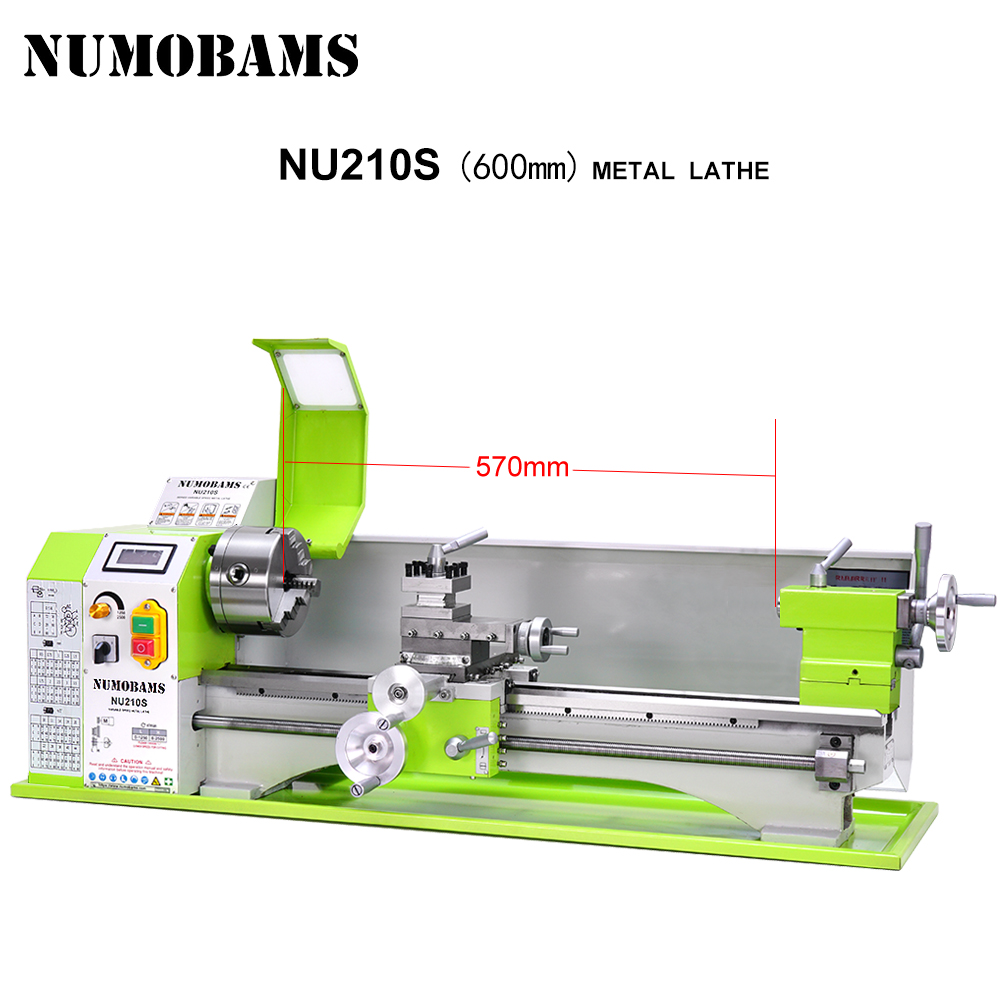
The NU210X600S is a compact metal lathe machine for the jobs that never justify a full-size machine: a worn shaft to re-cut, a bush to bore out, a stud that needs a thread, a spacer turned down to fit. Everything about it is sized for a bench in a garage, a repair bay or a prototyping room, and for parts you can pick up in one hand.
It turns, faces, bores and threads. The spindle is bored right through, so you can pass a length of bar through the headstock instead of hanging it out of the jaws, and the self-centering chuck grips round, hex and square stock without shimming. Speed is continuously variable, so you can slow right down for a thread and wind up for a small-diameter finishing pass.
This is a DIY metal lathe in the practical sense: it sits on a bench, it does not need a specialist to install it, and the controls are laid out the way any manual machinist already expects. Engineers, maintenance technicians and experienced home machinists get the most out of it; a shop that needs three shifts of production, bar feeders or a tool changer wants a different class of machine.
The machine comes to us from a lathe machine manufacturer we work closely with, and it arrives adjusted and calibrated rather than needing to be set up from scratch. If you already own MT5 tooling — centres, drill chucks, reducing sleeves — that is the point where an MT5 spindle lathe stops being a compromise.
Spindle, Chuck & Tooling Fit
- 38 mm spindle bore. Bar and long slender parts pass through the headstock of this mini metal lathe, so you can thread the end of a long rod or turn a shaft between centres without fighting the jaws.
- MT5 spindle taper. This MT5 spindle lathe takes standard MT5 centres, drill chucks and reducing sleeves at the spindle nose, so the tooling most benchtop metal lathe owners already have carries straight over. Check your sleeves and arbors against MT5 before you order if one particular tool is critical to your work.
- 6 mm spindle wall. The thicker wall at the nose keeps the chuck register rigid under parting and interrupted cuts, where a light spindle deflects and leaves taper in the part.
- 125 mm self-centering chuck, 3-jaw or 4-jaw. The 3-jaw scroll chuck centres round and hex stock in seconds, which is what most one-off work needs. Take the 4-jaw when you set up rectangular, cast or deliberately off-centre parts that have to be dialled in one at a time.
- MT2 tailstock. The quill takes standard MT2 drill chucks, live centres and revolving centres, the sizes you can buy anywhere, so supporting a long shaft or drilling from the tailstock never depends on a special order.
- Standard tool post. Ordinary square-section HSS and indexable turning tools clamp straight in; nothing about the tool post ties you to one supplier's inserts.
- Change gear set. Supplied with the machine so you can set the feeds and thread pitches you need without buying gears separately.
Specifications
| Parameter |
Value |
| Spindle bore |
38 mm |
| Spindle taper |
MT5 |
| Spindle wall thickness |
6 mm |
| Chuck |
125 mm self-centering |
| Swing over bed |
210 mm |
| Distance between centres |
600 mm |
| Spindle speed |
0–2500 rpm, continuously variable |
| Tailstock taper |
MT2 |
| Top slide travel |
55 mm |
| Carriage travel |
376 mm |
| Metric threads |
0.5–3.5 mm |
| Imperial threads |
10–44 TPI |
| Motor |
900 W brushless |
| Net / gross weight |
75 / 85 kg |
Motor & Variable Speed
The 900 W brushless motor is the reason this metal turning lathe can take a real cut instead of a polishing pass. Brushless means no carbon brushes to wear down, no brush dust inside the headstock and no arcing at the commutator, so torque holds up at the low end of the speed range — exactly where threading, parting and facing a shoulder happen.
Speed is continuous rather than stepped, so you match the spindle to the work instead of settling for the nearest fixed ratio. Run slow for a thread or a parting cut, wind up for a small-diameter finish pass in aluminium or brass. The control panel sits at the front of the headstock, with the speed control and the stop where your hand expects to find them.
Two limits are worth knowing before you buy. On a lathe of this size, depth of cut is decided by rigidity as much as by watts: light, repeatable passes in mild steel, aluminium and brass are what it is for, and heavy interrupted cuts in hard material belong on a bigger machine. And it is a workshop lathe built for intermittent work, not a production machine to run unattended all day.
Supplied With the Machine
- Cutting tool set. A set of turning tools sized for this metal lathe machine, enough to take your first cuts without placing a separate order.
- Drill chuck and live centre. For drilling from the tailstock and for supporting long work between centres.
- Change gear set. For the feed rates and thread pitches outside the settings already on the machine.
- Tool case. The hand tools — wrenches, hex keys, screwdrivers — arrive together, so nothing walks off the bench between sessions.
- Oil bottle and drive belts. Consumables you will need within the first few weeks, in the crate rather than on a shopping list.
- Spare chuck jaws. For when a jaw gets marked or you move to a different workholding setup.
- Chuck type and voltage are chosen at order, then fitted and checked before the machine is packed.
- Confirm the final accessory list on your order confirmation; the packing list that travels with your machine is the definitive one.
Guideway, Bed & Electrical Protection
The bed ways are the part of a metal lathe machine you cannot see working and cannot repair once they are worn. On this machine the ways are induction hardened and ground — the quenched guideway in the feature list — so the carriage can slide over them thousands of times without wearing a hollow that shows up later as taper in the part.
The electrical side is deliberately plain. The circuit board sits in a fully enclosed housing, which keeps chips, oil and coolant mist out of the most expensive thing on the machine to replace. CE power-off protection cuts power to the drive rather than letting the machine restart by itself after the supply is interrupted, and the stop on the control panel is where your hand goes first.
There is room to grow, too. The mounting holes for a thread dial indicator, a lead screw protection cover and a rear support are already drilled and tapped, so those can be added later without touching the bed with a drill. That is the kind of detail the lathe machine manufacturers we work with build in from the start rather than sell as a retrofit.
Workshop Applications
- Repair and maintenance benches. Turning a replacement bush, pin or spacer on the spot instead of waiting on a part, in a bay where the machine runs on the supply already on the wall.
- Prototype and product development. One-off housings, threaded adapters and spacers, with setups changed in minutes because the 3-jaw chuck re-centres on its own.
- Home and garage workshops. Model engineering, hobby turning and restoring older machinery — the DIY metal lathe work this machine is sized for.
- Training and technical education. Manual controls, a visible stop, and a machine several students can take turns on without a CNC interface in the way.
- Small fabrication and machine shops. Jigs, fixtures, threaded studs and shaft repair in short runs, where a bigger lathe would sit idle most of the week.
- Most owners use a workshop lathe like this one for two or three jobs a week rather than all day, and that is the duty it is built for.
Setting Up & First Cuts
- Check the crate before you sign for it. Photograph any crush damage and tell us the same day; a machine that has been dropped in transit is far easier to deal with before it is on your bench.
- Move it with two people or a hoist. Lift from the bed, never from the chuck or the tailstock quill.
- Bolt it down. A rigid bench or a proper stand, bolted through the mounting feet — a benchtop metal lathe has no mass to hide a flexing bench, and it shows up as chatter long before it shows up as a loose bolt.
- Clean off the shipping grease and re-oil. Wipe the preservative off the ways with a solvent-damp cloth, then oil the bed ways, the lead screw and the tailstock quill before the first cut.
- Seat the chuck on a clean register, and check runout with a dial indicator if you have one.
- Set the change gears for the feed or thread you plan to cut, following the thread chart.
- Run the first cut slowly. Low speed for cutting, a light pass in aluminium, and listen: chatter usually means the tool is too high, too far out of the holder, or the bench is not rigid enough.
- Download the parameter chart and dimension drawing from our Download Center before you position the machine, so your bench clearance is right the first time.
Maintenance & Wear Parts
A metal turning lathe stays accurate on a simple routine. Wipe the ways and the cross slide down after every session, oil them before and after, and keep the lead screw and change gears lightly greased. Chips left on the ways get dragged under the carriage, and that is where scoring starts.
Clean the chuck instead of blowing it out with an air line. Compressed air drives chips deeper into the scroll and towards the spindle bearings; a brush, a cloth and a little solvent do the job without that risk. If the jaws begin to bind, strip and clean the scroll rather than forcing them.
Check the drive belts for tension and cracking every few months, and keep the tailstock quill oiled. The parts that wear in normal use are the chuck jaws, the drive belts, the change gears and the control board — each one a separate item, so a worn jaw never means a new chuck.
Four habits worth avoiding: parting off with too much tool overhang, running a dull tool because the cut still looks acceptable, lifting the machine by the chuck, and leaving bare, unoiled ways over a damp winter.
Ordering & Delivery
- Dispatch. We dispatch within 90 days of order confirmation. Send us the full delivery address with your order so the route can be confirmed.
- Delivery. Tax-free delivery to door, so the machine arrives at your address rather than at a port or depot you have to collect from.
- Warranty. The control board is covered for 180 days from the day you receive the machine. Send the failed board back inside that window and we replace it; the cover is on the board, not on every component, and replacement boards come from the same lathe machine manufacturers who built the machine.
- Payment. Credit card or T/T bank transfer — confirm the details with our team when you place the order.
- Bulk and repeat orders. Agents, local brand owners and buyers taking more than one machine should ask us about quantity terms before ordering.
- Support. Advice on which model suits the work, help with the first setup, and technical answers from our own team rather than through a reseller chain.
- What we supply. Lathes, milling and drilling machines, tooling, accessories and spare parts, from the manufacturing partners we have worked with since 2016.
The Wider NUMOBAMS Range
The NU210X600S sits in the middle of a range that runs from compact training lathes to long-bed machines, and the approach is the same across all of them: manual controls, standard tapers, and parts you can order later.
When thread work is the main job, the NU210LSE adds automatic left and right threading, electronic change gears and two chuck heads on a 1000 mm bed. The NU320B keeps the MT5 tooling standard in a 320 × 600 mm envelope with a 750 W motor. For heavier cuts, the NU330V Plus moves up to a 1500 W motor and a 160 mm chuck; the NU6136 takes a 355 × 1000 mm workpiece with a 1.5 kW motor and a 160 mm chuck; the WL800 is built for heavy processing; and the NU260V-700 is the compact bench model we supply for workshops and teaching.
The lathe machine manufacturers behind these models build to the same standard, which is why tooling and workholding habits carry from one machine to the next.
Supply Chain & Delivery Assurance
NUMOBAMS is a China-based machinery trading company working from Changsha, Hunan, with a selected network of manufacturing partners built up since 2016. That position lets us consolidate a full workshop order — machines, tooling and spare parts — into one shipment, inspect and prepare each unit before dispatch, and keep spare parts available long after delivery. We ship to Europe, the US and Canada on a tax-free, door-to-door basis, and usually dispatch within 90 days of order confirmation.
FAQ
Q1. Can this lathe cut threads?
Yes. The machine threads in both metric and imperial, and the pitches are set through the change gear set supplied with it; the thread chart on the machine lists every setting. Turn, face and bore work runs off the same carriage feed, so threading is a change of gears rather than a change of machine. If thread work is going to be most of what you do, the NU210LSE is the model in the range built around it.
Q2. Is 900 W enough to turn steel?
For light and medium passes in mild steel, yes — 900 W through a brushless motor holds torque well at the low speeds where steel is turned. Depth of cut on a bench machine is limited by rigidity as much as by power, so plan on several light passes rather than one heavy one. Aluminium, brass and plastics are comfortable. Hardened stock and heavy interrupted cuts on large diameters are not what this machine is for.
Q3. How do I check the accuracy when the machine arrives?
Every unit is adjusted and calibrated before it is packed, so the check is a cutting test rather than a strip-down. Take a light pass on a test bar in aluminium or mild steel and measure the result. Please do not dismantle the headstock or the carriage to inspect alignment — the calibration is set on the assembled machine, and accuracy problems that follow disassembly are outside what we can stand behind.
Q4. Can I have it configured for my workshop?
Choose 110 V or 220 V and either the 3-jaw or the 4-jaw chuck when you order, and the machine is fitted and checked before it is packed. If your work needs something beyond the standard build, tell us what you are turning and which tooling you already own, and we will tell you what can be changed and what cannot.
Q5. Is the machine in the photographs the one that ships?
The machine ships with the accessory set shown with it — cutting tools, drill chuck, live centre, change gear set, tool case, hand tools, oil bottle, drive belts and spare jaws — plus the chuck and voltage you selected. The packing list that travels with your machine is the final list; check it on arrival and tell us within the first week if anything is missing.
Q6. Is this a sensible first lathe?
It can be, if you are willing to learn on a manual machine. A DIY metal lathe of this size rewards practice: the controls are conventional, the chuck self-centres, and the low speed range is forgiving while you find your feet. What it will not do is work unattended — every cut is set by hand, which is exactly why it teaches you what the tool is doing.
Q7. Where does this lathe come from and who supports it?
It is built for us by a lathe machine manufacturer we have worked closely with, and every unit is adjusted and calibrated before it leaves. Support after delivery comes from our own team rather than through a reseller chain, and the boards and wear parts that fail in service come from the same production as the machine.